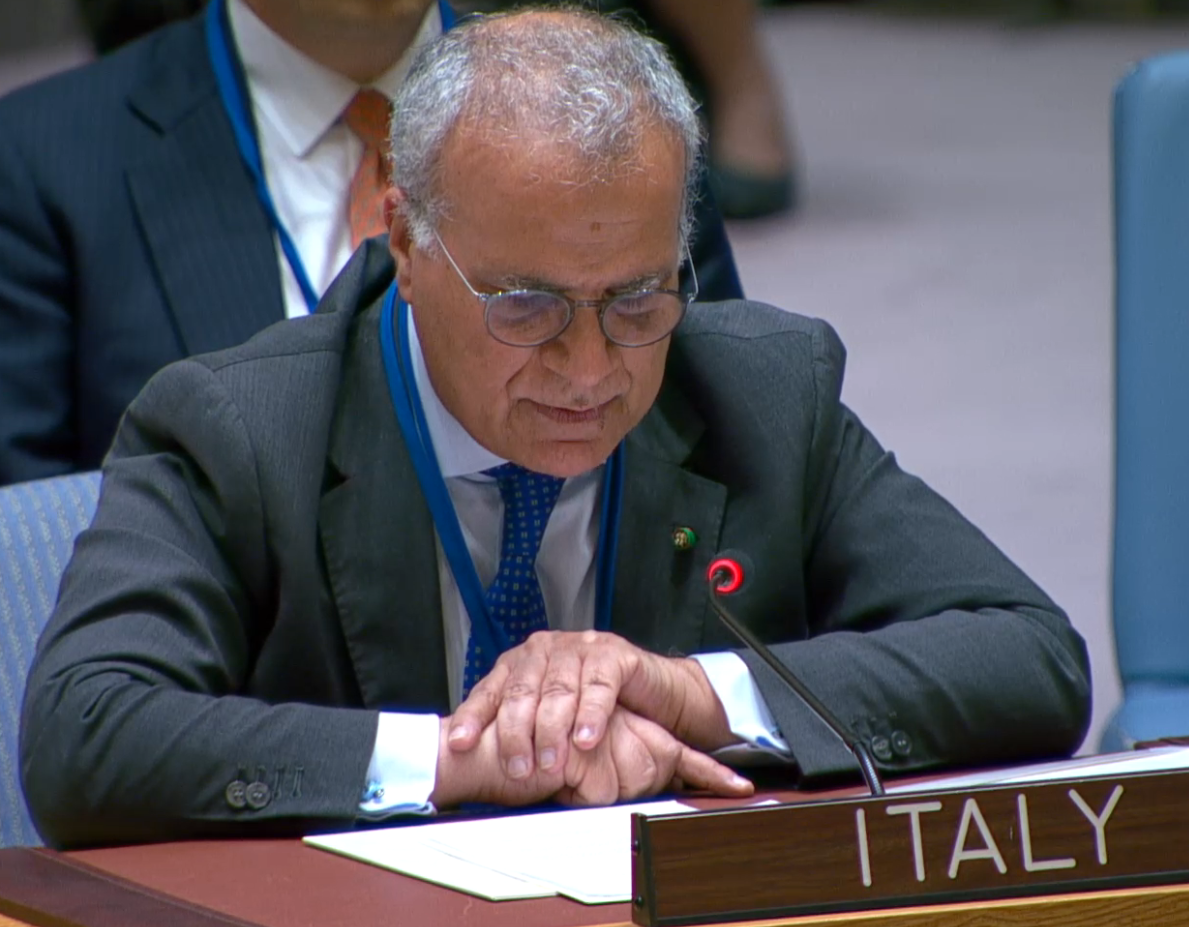
Mr. President, Excellencies,
Italy aligns itself to the statement delivered by the European Union and would like to add some further remarks in its national capacity.
Let me start by quoting the Secretary-General Guterres stressing that “without maritime security, there can be no global security”. It is essential for the Security Council to maintain a focus on the increasing threats to maritime security and freedom of navigation. In this spirit, we commend the Presidency for convening today’s timely debate
Maritime threats — such as piracy, terrorism and various illicit activities, including migrant smuggling and the trafficking of arms and drugs — have wide-ranging implications for security, the economy and the environment. Furthermore, today, we are witnessing practices that weaken the very principle of freedom of navigation, putting it into under enormous stress.
To stop and reverse this worrying spiral, we need to act collectively in some key aspects.
First, we must abide by international law. We take this opportunity to recall that UNCLOS is the legal framework within which all activities at sea must be carried out. States have the primary responsibility to comply and to ensure compliance with the obligations contained therein, including those related to maritime security.
Second, we must reaffirm the importance of the Security Council’ role in addressing maritime security in an integrated manner and across different regions. Building on the legal foundation provided by the UNCLOS, and other key conventions — such as the Convention for the Suppression of Unlawful Acts against the Safety of Maritime Navigation – the Security Council can offer guidance to resolve any disputes or disagreements with regard to maritime security in accordance with the Charter of the United Nations.
Third, every Member States must do its part to translate the Security Council’s recommendations into concrete actions. Italy has been supporting international efforts against transnational organized crime at sea, and shared best practices for preventing and combating terrorism and to safeguard the security and well-being of seafarers, while working closely with regional and sub-regional organizations.
Within G7++ Friends of the Gulf of Guinea Group, we support the development of the regulatory and capacity-building framework of the countries and the regional institutions that are part of the Yaoundé Architecture, and contribute to the maritime security in the region through the periodic presence of units of the Italian Navy. In the Red Sea region, Italy is actively engaged in Operation ASPIDES, working to protect vital shipping lanes in accordance with UNCLOS and UN Security Council Resolution 2722.
In the same vein, we welcome a multilateral approach to ensure maritime security and freedom of navigation in the Strait of Hormuz, where unilateral actions such as the unlawful application of a toll system threaten safe and free navigation, as well as the right of transit passage.
Disruptions in the Strait of Hormuz have direct implications for the security of maritime routes, global energy supplies, and food security. Italy supports all negotiated solutions aimed at ensuring stability in the region and stands ready to contribute to efforts to safeguard freedom of navigation and to preserve the stability of global markets. We believe that any international mission should be strictly defensive in nature, coordinated with regional and international partners and deployed only once hostilities have ceased. Italy reiterates its solidarity towards the Gulf countries affected by unacceptable retaliatory strikes.
Italy will remain steadfast in its commitment to upholding freedom of navigation globally and reinforcing the law of the sea.
Thank you.