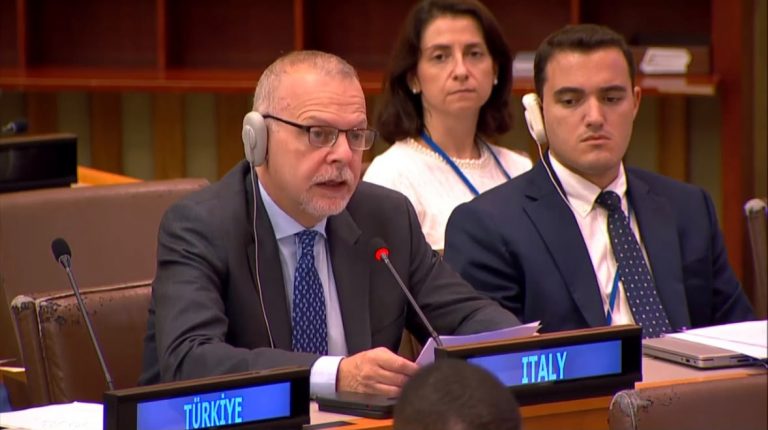
Wednesday, 19th August 2026
Madam President,
I thank you for convening this meeting on a topic which is of the utmost importance and deserves our continued attention. The international community has a vital interest in a Security Council that is efficient and effective in carrying out its primary responsibility for the maintenance of international peace and security, which is critically needed in today’s complex global environment.
Madam President,
The “Uniting for Consensus” Group has tabled a proposal for the reform of the Security Council which also encompasses concrete ideas on the working methods of this body. Flexible, inclusive and transparent decision-making processes are key aspects of any reformed Security Council, as well as of an enhanced relationship between the Council and the General Assembly.
Inclusive working methods, in particular, should entail the possibility for all elected members to play a greater role in the Security Council. The distribution of duties among the Council Members should be fairer and more balanced when it comes both to the chairmanship of subsidiary bodies and to the practice of penholderships and co-penholderships. Moreover, it is essential that views and interests of Member States affected or concerned by any matter on the agenda of the Council-including Troop and Police Contributing Countries and host Countries – be heard and taken into account in its work.
The working methods of the Security Council, as well as its relationship with the General Assembly, can be improved through several measures, among which:
- Formal adoption of the rules of procedure of the Security Council.
- Increased quality and enhanced analytical content of the Security Council’s Annual Report to be presented during a special session of the General Assembly.
- Continuing to increase the transparency of the work of subsidiary bodies, also by improving the quality, frequency and availability of their formal and informal reports and summary records. We invite Council’s members to increase efforts to reach an agreement on the appointment of chairs and vice-chairs of these bodies.
- Offering Member States more informal opportunities to interact with the subsidiary bodies.
- Frequent, timely and more informative briefings for non-Council members on matters discussed in Security Council closed meetings and informal consultations, and in its subsidiary bodies.
- More and better access to information through open briefings and interaction between the Council and all interested and involved parties, including regional and sub-regional organizations.
- Timely availability to non-Council members of draft resolutions and presidential statements, as well as other Security Council documents (such as elements to the press and notes by the President).
We also strongly support the practice of inviting briefers from civil society to Council meetings, ensuring adequate women’s participation and greater gender inclusivity and equality, in order to allow the Council members to hear different voices and points of view before deliberating.
It is furthermore important to ensure that public meetings remain the primary format for the Security Council’s work, while limiting closed meetings and informal consultations to exceptional cases, in keeping with their original purpose.
Madam President,
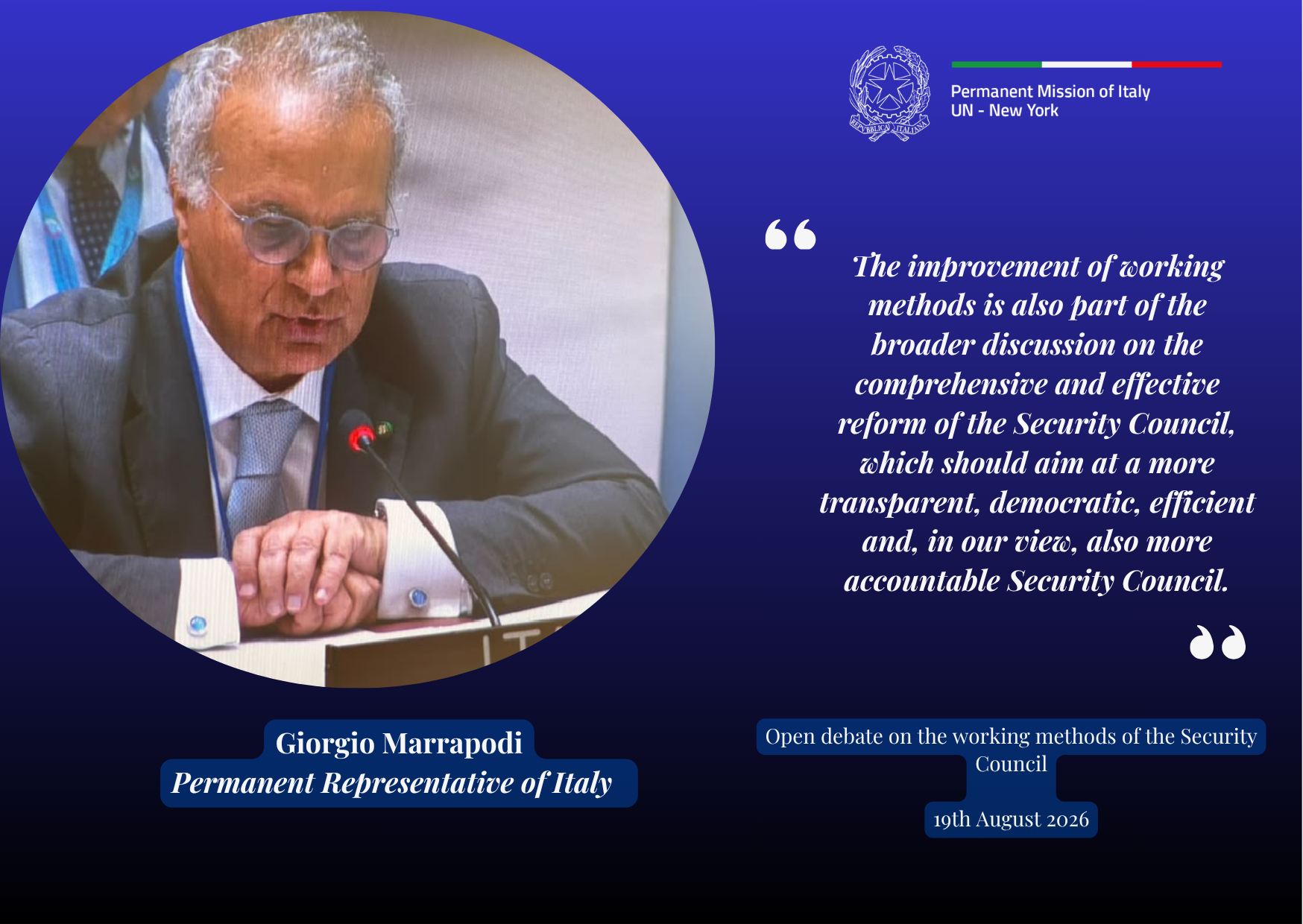
The improvement of working methods is also part of the broader discussion on the comprehensive and effective reform of the Security Council, which should aim at a more transparent, democratic, efficient and, in our view, also more accountable Security Council.
It is hard to speak of working methods without reflecting at the same time on the root causes of the Council’s inaction, which are directly and closely linked to the veto, regardless of whether it is actually used or simply threatened.
This is why Italy supports all initiatives aimed at self-restraining the exercise of the veto – such as the French-Mexican initiative and the ACT Code of Conduct – and was among the co-sponsors of the GA resolution 76/262 known as the “veto initiative” spearheaded by Liechtenstein. This is also the reason why we do not support the expansion of the Security Council in the category of Permanent Members, as it would generate additional vetoes and further discrimination and divisions among Council members thus making it less efficient, less democratic, less accountable to the general membership.
I thank you.