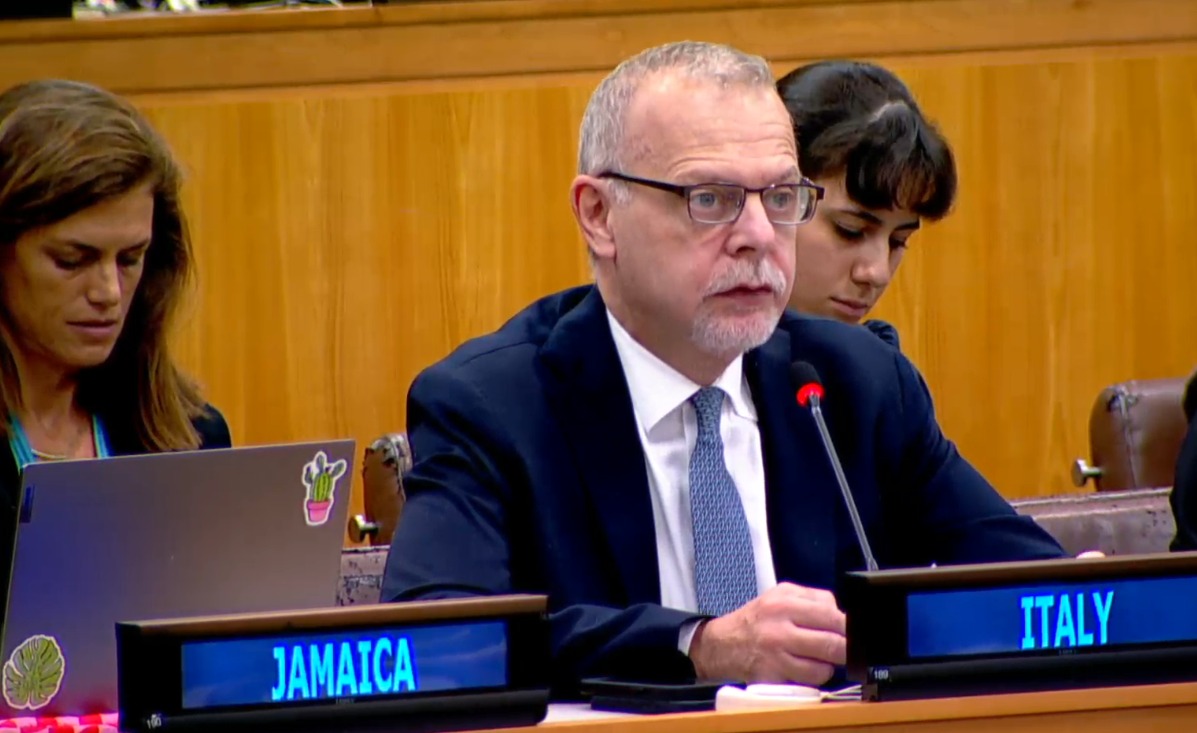
Madam Chair,
Italy aligns itself with the statement delivered by the European Union and wishes to add some remarks in its national capacity.
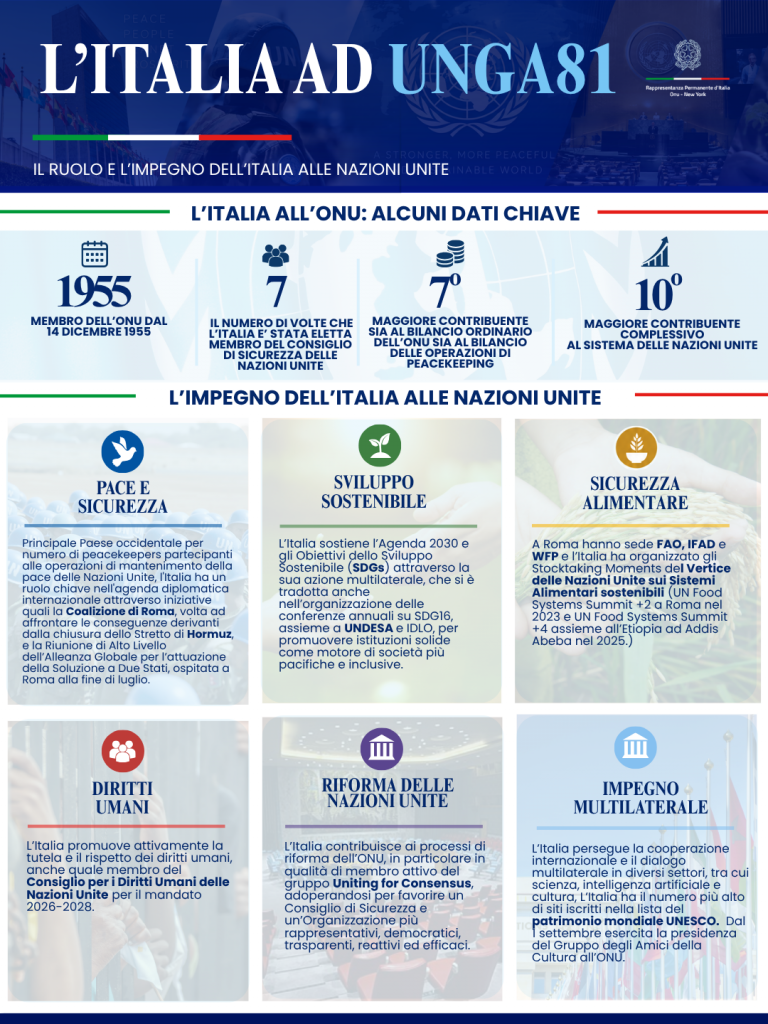
It is our firm conviction that human rights constitute the very foundation upon which just, peaceful and inclusive societies are built. This conviction is also enshrined in the fundamental principles of the Italian legal system, on the basis of which Italy considers human rights essential to foster international peace and security, and to strengthen the rule of law. In this regard, our re-election, in October 2025, as a member of the Human Rights Council for the 2026-2028 term reaffirms our unwavering commitment to the universal protection of human rights.
Madam Chair,
we would like to take this opportunity to highlight key issues that guide our commitment to the promotion and protection of human rights.
First of all, Italy remains firmly committed to the universal abolition of the death penalty. We believe that capital punishment, as a cruel, inhuman and degrading treatment, is incompatible with the right to life and human dignity. It does not contribute to greater security or to the prevention of crime; while its irreversible nature leaves no possibility of remedy once a judicial error has occurred. Italy has long been at the forefront of international efforts towards abolition. In 2024, also thanks to Italy’s commitment as co-facilitator, the Resolution (79/179) for a Universal Moratorium of the Death Penalty, received, for the first time, the support of more than two-thirds of the members of the United Nations, with 130 votes in favour.
With regard to violence against women, Italy’s position remains unequivocal: harmful practices such as female genital mutilation and early, child and forced marriage, together with every other manifestation of gender-based violence, constitute grave violations of human rights and a major obstacle to achieving gender equality. We call upon all States to guarantee survivors effective access to justice and to address the root causes of such violence, in order to prevent its recurrence. At the national level, we are proud to announce that Italy has introduced femicide as a distinct criminal offence, punishable by life imprisonment, alongside strengthened victim-support mechanisms and measures to promote women’s economic independence, which are essential factors in enabling women to break free from cycles of violence and abuse.
Italy’s commitment extends beyond the prevention of violence to the removal of structural obstacles that continue to hinder women’s participation in decision-making and professional advancement. Italy currently co-chairs, together with the Philippines, the Network of Focal Points on Women, Peace and Security, whose eighth Capital-Level Meeting was convened in Rome this past June. This reflects our continued commitment to advancing gender equality and to ensuring that women can fully and meaningfully contribute to decision-making processes. This commitment is all the more important in the context of today’s unprecedented humanitarian crises, which continue to have a disproportionate impact on women and girls. Italy’s longstanding efforts to promote women’s empowerment and gender equality are rooted in the recognition that meaningful and effective inclusion of women in all areas of public life is essential to fostering lasting change, strengthening peaceful coexistence and building more inclusive societies.
Italy firmly believes in the key contribution of youth to multilateralism and international cooperation, and is committed to ensuring that youth participation is not only a matter of principle, but is supported by concrete institutional structures and measurable action. Since 2017, Italy has implemented a United Nations Youth Delegate Programme, providing young people with a direct channel to participate in international policymaking. Since 2018, this commitment has also been reflected in the establishment of the National Youth Council, a formal advisory body bringing together youth organisations from across the country. Building on these efforts, Italy became the second country in Europe to adopt a National Action Plan on Youth, Peace and Security. The Plan, for the period 2026–2029, includes concrete measures such as a dedicated funding line to support youth participation in international peace and security processes, an increase in the number of Italian UN Youth Delegates, as well as the establishment of a permanent Youth Forum on foreign policy. Its implementation is overseen by a National Steering Committee on the YPS Agenda, with periodic reporting and evaluation against the five pillars of the YPS Agenda. This monitoring framework helps ensure accountability and assess progress towards concrete outcome, ensuring that commitments to youth participation are translated into sustained institutional action and measurable results.
The protection of children in armed conflict remains a matter of grave concern to Italy. Despite three decades of normative progress within the United Nations, recent reports point to an alarming increase in grave violations against children, including attacks on schools and hospitals, recruitment, sexual violence and the denial of humanitarian access, compounded by the growing use of autonomous aerial systems and artificial intelligence in battlefield targeting. Children must never be regarded as an acceptable cost of armed conflict. Italy therefore reiterates its call for the full implementation of Security Council resolution 2601 and for the broadest endorsement of the Safe Schools Declaration.
Similarly, violence against children in all its forms must be eradicated wherever it occurs. Italy is firmly committed to ensuring that the rights of children – especially those in situations of vulnerability – are protected everywhere and that every child can grow up free from abuse, trafficking, exploitation or other forms of violence, including in digital environments.
Madam Chair,
Several of these concerns converge in the rapid advancement of artificial intelligence and emerging technologies. Women represent barely one in five artificial intelligence professionals worldwide and hold fewer than one in seven senior leadership positions in the sector. At the same time, the growing use of artificial intelligence can amplify online abuse targeting women and girls, while reinforcing gender stereotypes and existing patterns of structural discrimination. Children are also exposed to these emerging risks, including persuasive disinformation, misleading deepfake content and the potential misuse of generative AI systems. Italy calls for strengthened international cooperation to ensure that the governance of artificial intelligence remains firmly grounded in human rights and effectively addresses the specific risks faced by women, girls and children.
The fight against all forms of discrimination remains central to our human rights agenda. We believe that any form of discrimination is fundamentally incompatible with the universality and indivisibility of human rights. Italy has given concrete expression to this principle through its Third National Action Plan for the Rights and Inclusion of Persons with Disabilities, grounded on the importance of ensuring persons with disabilities greater autonomy in decisions concerning their lives. In addition, Italy has undertaken a broader reform establishing a national Guarantor Authority for the rights of persons with disabilities and introducing the “Life Project”, conceived to overcome the fragmentation between healthcare and social services. The same principle informs Italy’s approach to its ageing population, whose needs call for coordinated policy and sustained investment in lifelong learning, so that older workers are not left behind by the green and digital transitions.
Lastly, we wish to underscore the importance of culture and dialogue in fostering mutual understanding, respect, tolerance, and in promoting human rights. Cultural diversity should be valued as a source of enrichment for all humanity, while fully preserving the universality and indivisibility of human rights. At the same time, cultural heritage must be safeguarded, particularly in situations of armed conflict, where cultural sites and traditions are too often deliberately targeted. In this regard, Italy has taken a concrete step by co-chairing, since September 2026, together with Mexico, the Group of Friends of Culture, working to give culture a more central place on the United Nations agenda, including through the responsible use of artificial intelligence to document and safeguard cultural heritage.
Madam Chair, Italy stands ready to work with all Member States, in a spirit of dialogue and cooperation, to address these pressing challenges and to ensure that human dignity and rights are upheld for all.
I thank you, Madam Chair.