President,
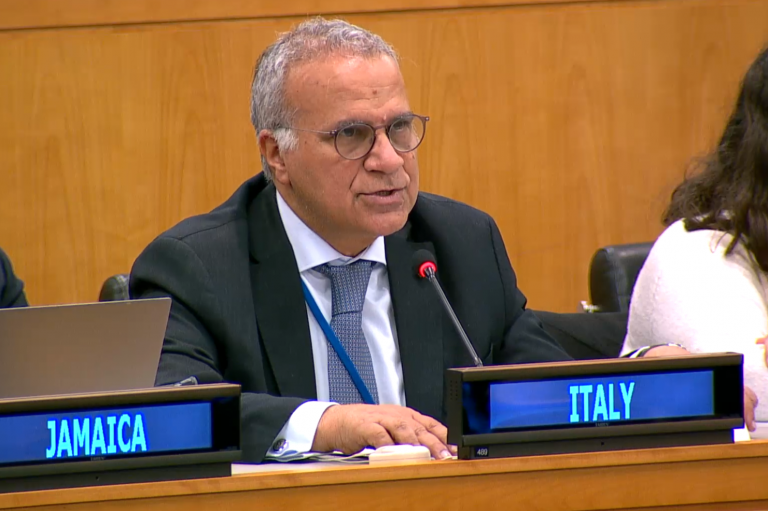
Italy aligns itself with the statement delivered by the European Union andwishes to make the following remarks in its national capacity.
Italy welcomes the convening of this High-Level Open Debate. Indeed, weare living in an Era of Technological Change, a change that is unfolding at aspeed which, in all likelihood, is unprecedented in human history.
Occasions like the one of today are fundamental to focus on the challenges and opportunities ahead of us and to address them in the presence of the international Community gathered in the United Nations. Even if at the time the UN was established it was not possible to foresee how technology would evolve, it is a fact that, by mandate enshrined in its Charter, this Organization is called to achieve international co-operation in Permanent Mission of Italy to the United Nations – New York, solving international problems of an economic, social, cultural, or humanitarian character. This is the reason why we are gathering here today, as the growing dependence of our societies on digital technologies has changed in its very essence our everyday life and constitutes a fundamental element of our common effort to promote international peace and security, starting from the prevention and solution of conflicts.
This is particularly true in an era of so called “polycrisis”.
ICTs and other technologies, in particular when powered by Artificial Intelligence or Quantum technologies, offer extraordinary opportunities for development and innovation, and also for the most efficient performance of the mandates decided by this organ, the Security Council, starting frompeacekeeping operations. Nonetheless, at the same time, their malicious use can provoke damages of unimaginable proportions. In the last few days Italy has experienced the unpleasant effect of the harmful use of ICTs.
My Country is just one of the many that, in the last few months, have experienced malicious hybrid activities, including through foreign information manipulation and interference. Moreover, we should not forget that technological improvements can also increase civilian casualties when they are applied to warfare. Unmanned Aerial Vehicles (UAVs) and low-cost drones, for example, have fundamentally transformed modern warfare, dramatically shifting how conflicts impact civilian populations and testing the boundaries of international law. Declarations of principles to condemn these realities are not enough: we need to work tirelessly to enhance prevention and preparedness and to respond adequately to malign actions using new technologies. That is why international cooperation remains fundamental, as well as confidence building measures and capacity building, to which Italy is particularly committed.
In fact, the domain of new technologies does not contemplate borders and does not distinguish between developed and developing Countries. That is why we believe that the magnitude of the challenges weare already facing needs to be addressed in good faith by the whole international Community. Italy firmly believes that international law – including human rights law and international humanitarian law – provides the essential foundation forstability also in the digital domain and for the best use of new technologies, in any field, including the one related to conflict management in its wholecycle, from prevention, to early warning, to resolution.
Our common task is not to resist technological innovation, but to ensure that it develops within a framework promoting responsibility, transparency, human-oversight, cooperation and respect for international law. We are deeply convinced that in order to achieve this goal we need to move from a simple, while at the same time crucial, concept: the human beingmust remain at the center of any technological development and of any useof technology. Therefore, Italy stresses the importance of a shared governance of emerging technologies, based on human-centric and security-by-design approaches.
Technology has to remain an instrument to improve our life, both as individuals and as a community. It cannot become an end in itself. The success in ensuring that the benefits of the rapid technological change we are living outweigh the risks depends on this. Furthermore, we must never forget the reasons why the United Nations wasestablished. If we have them clear and we remain committed to them, we will be able toaddress all the challenges ahead of us and to engage for the benefits oftechnology to reach every corner of the world.
I thank you, Mr. President.