New York 28 gennaio 2026
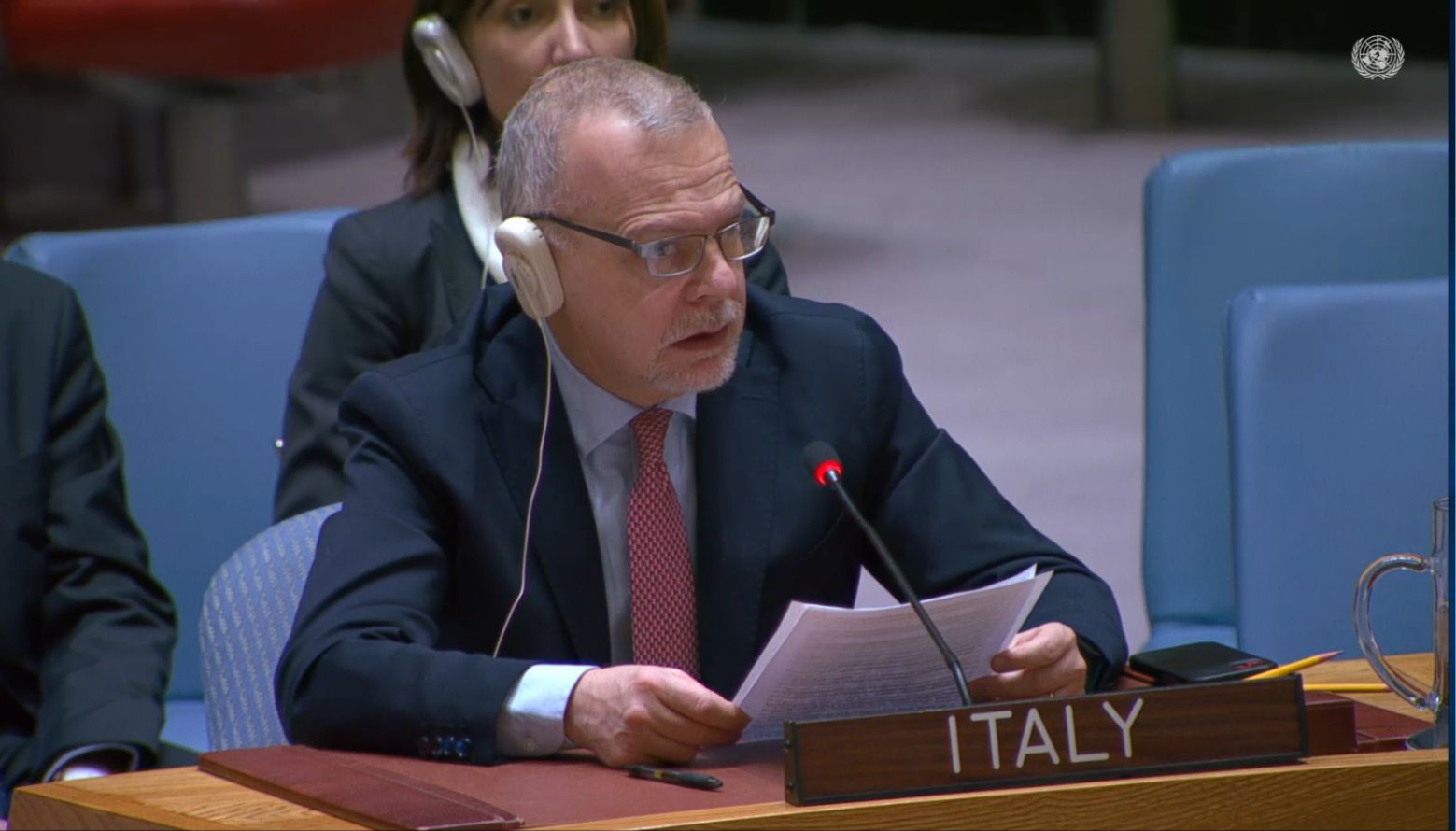
Thank you Mr. President,
We align ourselves with the statement delivered on behalf of the European Union and its Member States and wish to offer the following remarks in our national capacity.
The situation in the Middle East is fluid, characterised at the same time by instability and unresolved disputes, as well as by historic achievements and positive developments.
In this context, Italy believes that the international community must proceed with continued attention and active engagement, without underestimating the progress made.
Instead, we must build on the results achieved in order to achieve peace in the region.
Regarding Gaza and the Israeli-Palestinian conflict, the adoption of Resolution 2803 by the Security Council was both a milestone and a starting point.
Two months later, the United States have announced the launch of Phase Two of the Comprehensive Plan to end the Gaza Conflict, that the Resolution endorses.
We do not forget the compromise that made this development possible, and we welcome the return to Israel of the body of the last hostage still held in Gaza.
At the same time, we note with great concern the humanitarian catastrophe still unfolding in the Strip, where access continues to be insufficient and subject to excessive restrictions.
The full opening of all crossing points for both vital aid and reconstruction materials is fundamental to allow for the recovery and the development of the Strip.
The United Nations and NGOs should be enabled to play a central role in assisting the civilian population in Gaza, as envisaged in the Trump Plan and in the Resolution 2803.
From the outset, Italy has strongly supported UN Security Council Resolution 2803 and commended the mediation efforts by the US, Egypt, Qatar and Türkiye.
We renew our commitment to the full implementation of the US Peace Plan, as well as our support for the tremendous diplomatic work ongoing for the disarmament of Hamas.
We believe that coordination among partners and international engagement are key to protect the ceasefire, secure peace and build a future for the Palestinians.
The deployment of the International Stabilization Force (ISF) can make the difference.
Italy will contribute to the training of the Palestinian police under the scope of the ISF.
We welcome the appointment of a Palestinian National Committee for the Administration of Gaza that enjoys the support of the Palestinian Authority.
The ultimate goal is the two-State solution, with Israel and Palestine living side-by-side in peace and security. The end of Hamas’ rule over Gaza is a crucial step in this direction.
We closely monitor the situation in the West Bank and condemn in the strongest terms settler violence, settlement policies, and all actions aimed at jeopardise the perspective of a viable Two-state solution.
In the same spirit, Italy will continue to support the Palestinian Authority and its program of reform, encouraging the definition of a clear timetable to monitor its progress.
Bold policies need resources. We call on Israel to release withheld clearance revenues and to extend the correspondent banking services between Israeli and Palestinian banks.
The beginning of Phase Two of the Comprehensive Peace Plan is an opportunity that we cannot miss, with potential positive spillovers in the entire Middle East.
In Syria, we have witnessed hostilities broken out between Damascus and the Syrian Democratic Forces (SDF). We call on the parties to fully respect the agreements.
In line with our support for an inclusive political transition that guarantees the rights and participation of all Syrians, we reiterate our call for a peaceful integration of the Kurds.
One year after the fall of the Assad regime, the current phase represents a crucial test for the transitional Government, in economic, political and security terms.
We trust that President Sharaa and the Syrian authorities will honour the commitments they have made to the international community and, mostly, to the Syrian people.
We believe it is important to support Damascus in taking responsibility while facing demanding challenges, such as the control of the North-East and the fight against Daesh.
Turning to Lebanon, we applaud the direction taken under the leadership of President Aoun with regard to economic reforms and the disarmament of Hezbollah.
We believe that there are margins to overcome the institutional and financial crisis.
To this end, respect for the ceasefire on both sides of the Blue Line and the stabilization of Southern Lebanon are fundamental, also with a view to reconstruction efforts.
We warmly welcomed the announcement that the Lebanese Armed Forces (LAF) have completed the first phase of the plan for the State monopoly on weapons.
We continue to support the pivotal role played by UNIFIL in easing tensions along the Blue Line, contributing to de-escalation and ensuring the implementation of Resolution 1701.
We are concerned by the frequent incidents that are lately occurring at the expenses of UNIFIL. We would like to remind the IDF that any action against the safety of peacekeepers are serious violations of Security Council resolution 1701 and hinder the prospects to achieve a sustainable peace.
At the head of UNIFIL for the fifth time, Italy will continue to support the LAF: strengthening their capabilities is crucial now that the UN mission is drawing to a close.
Finally, we call for the resumption of the talks between Israeli and Lebanese civil representatives, to find a lasting agreement that puts an end to the threat of Hezbollah, as well as of Israeli raids and military presence in Lebanon.
Thank you Mr. President.