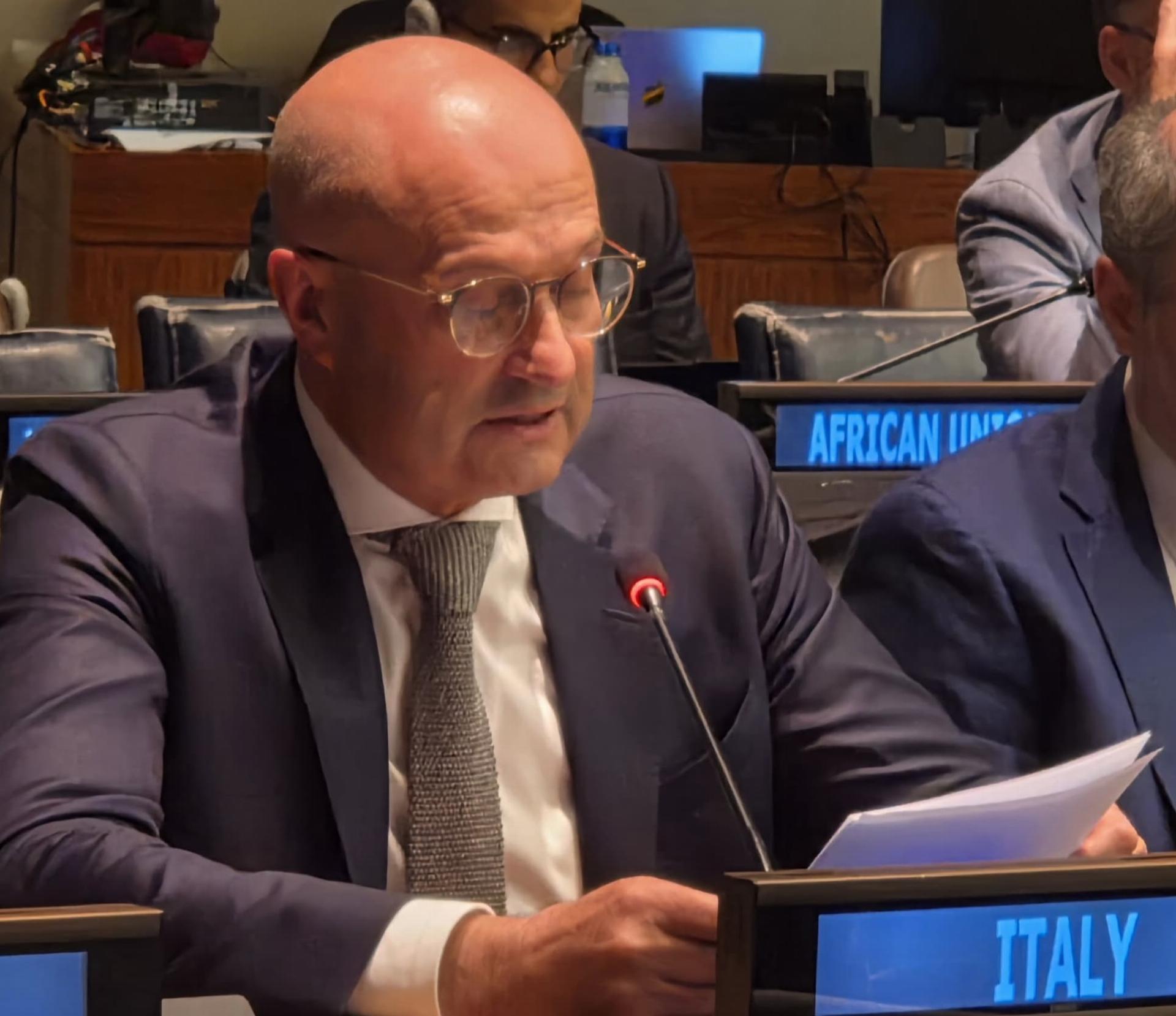
New York, 12 October, 2026
Chair,
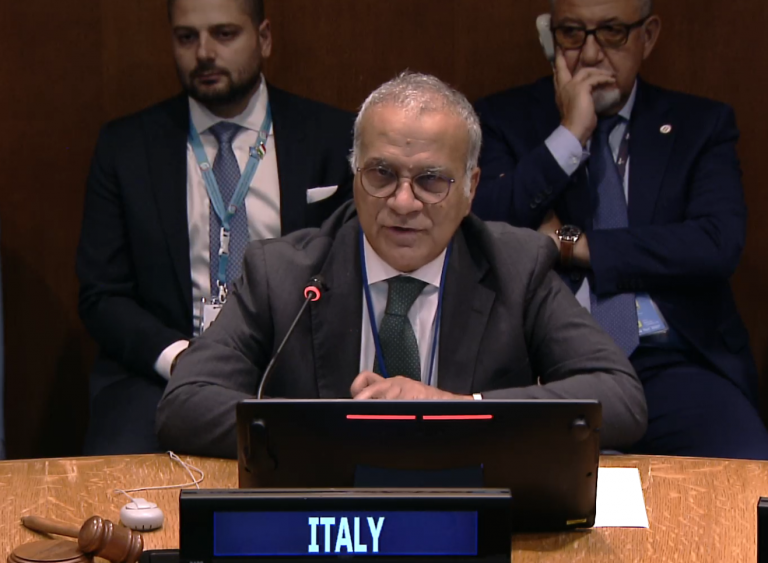
Italy aligns itself with the statement delivered by the European Union. I will now add some remarks in my national capacity.
We meet at a time of growing international polarization, with conflicts and tensions deepening, first and foremost as a result of Russia’s ongoing war of aggression against Ukraine. The international disarmament, non-proliferation and arms-control architecture is under increasing pressure.
The Eleventh NPT Review Conference once again highlighted the importance of sustained dialogue and of convergence, even where consensus remains elusive, to advance the full implementation of the Treaty across its three mutually reinforcing pillars.
This makes our responsibility particularly heavy. At a time when confidence in multilateralism is being tested, we must preserve existing instruments, strengthen their implementation and continue seeking areas where concrete progress remains possible.
Chair,
New and emerging technologies are transforming our societies, our economies and the way wars are fought. Their military applications, and artificial intelligence in particular, have become one of the most pressing challenges.
Technological progress cannot be stopped, nor should it be feared in itself. But innovation cannot outpace our capacity to establish rules, responsibilities and safeguards. Human beings must remain responsible for decisions concerning the use of force, and international humanitarian law must remain fully applicable regardless of the technologies employed.
Against this background, the consensus reached this year by the Group of Governmental Experts on Lethal Autonomous Weapons Systems is an important and encouraging signal. We should build on this achievement and transform convergence into progress, approaching the next stage of our work with pragmatism and openness.
Chair,
Geneva remains one of the world’s principal diplomatic hubs for disarmament, non-proliferation and arms control. We need to address the long-standing stalemate in the Conference on Disarmament, the world’s single multilateral forum specifically mandated to negotiate disarmament agreements.
Italy’s Presidency of the Conference in 2025 sought to demonstrate that progress remains possible. Through extensive and inclusive consultations, the Conference was able, already at the opening of its session, to adopt a Program of Work and establish five subsidiary bodies covering the main items on its agenda.
The lesson remains valid today: when delegations engage in open dialogue and genuinely search for areas of convergence, results can be achieved even in a difficult political environment. Against this background, developments in 2026 are particularly regrettable. Russia’s repeated exclusion of observer States and its use of the consensus rule as a de facto veto have further constrained a body the CD already struggling to fulfil its mandate. Consensus should be an instrument for building agreement, not for preventing the Conference from functioning.
Progress on the core issues of the Conference remains essential. Italy continues to attach the highest importance to the entry into force and universalization of the Comprehensive Nuclear-Test-Ban Treaty. Thirty years after its opening for signature, bringing the CTBT into force remains an unfinished task that the international community must address. We also continue to support the immediate commencement in the Conference on Disarmament of negotiations on a treaty banning the production of fissile material for nuclear weapons or other nuclear explosive devices, on the basis of the Shannon Mandate. An FMCT remains an indispensable next step.
Chair,
The same responsibility applies to the Biological Weapons Convention. Italy hopes that the Working Group on the strengthening of the Convention will reach consensus on a meaningful package of measures. Strengthening the Convention is particularly important as scientific and technological developments open extraordinary opportunities but may also generate new risks.
Outer space is another domain where rapid technological development and growing strategic competition make preventive diplomacy indispensable. Italy strongly supports efforts to preserve outer space as a peaceful, safe, secure environment and to reduce the risks of misunderstanding, miscalculation and conflict. We therefore attach great importance to the work of the Open-Ended Working Group on the Prevention of an Arms Race in Outer Space.
We hope that the same constructive approach will also prevail during the present session of the First Committee.
Chair,
Humanitarian disarmament remains an essential component of the international disarmament architecture. The Anti-Personnel Mine Ban Convention and the Convention on Cluster Munitions have established strong humanitarian norms and produced tangible results for affected communities. Recent developments, including withdrawals from the APMBC and renewed concerns regarding the use of weapons prohibited by these instruments, make preserving their integrity and strengthening their universalization more important than ever. Italy remains firmly committed to both Conventions, to their full implementation and to assistance to affected States and populations. We must ensure that difficult security circumstances do not lead us to lose sight of the humanitarian principles on which these instruments were built.
These instruments are not relics of a different geopolitical era. The deterioration of the international security environment makes their rules, institutions and safeguards more necessary than ever.
The challenges before us are therefore considerable, from nuclear disarmament and non-proliferation to conventional weapons.
They cannot be addressed by weakening the institutions and instruments we have collectively built.
At a time when weapons appear to speak louder than words, our responsibility is to ensure that diplomacy finds its voice again.
Italy is ready to do its part.
I thank you, Chair.