(18 Ottobre, di Stefano Vaccara)
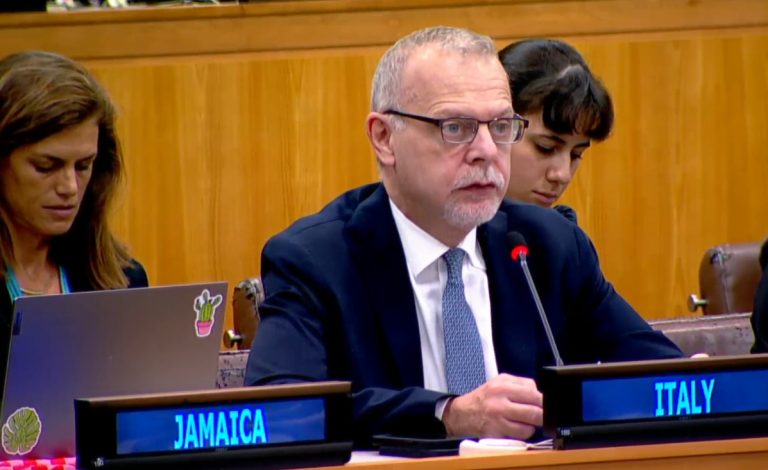
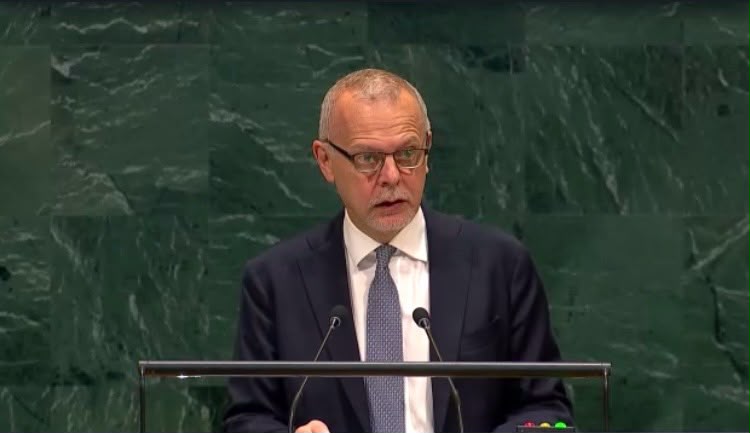
WASHINGTON (UNITED STATES) (ITALPRESS) – Nearly forty years of diplomatic service, from Calabria to the United Nations Headquarters in New York, with postings in some of Europe’s major capitals along the way. Giorgio Marrapodi, Ambassador and Permanent Representative of Italy to the United Nations, was among the leading figures at the fourth edition of the ITALPRESS Awards, held in Washington on the occasion of the NIAF Annual Gala, where he received an award alongside his colleague Marco Peronaci, Italy’s Ambassador to the United States.
Other award recipients included Attilio Fontana, President of the Lombardy Region; Tommaso Tanzilli, Chairman of Ferrovie dello Stato Italiane; and journalist and LUISS professor Gianni Riotta. It was on this occasion that we met Ambassador Marrapodi for an interview spanning nearly forty years of Italian diplomacy and addressing some of the most pressing challenges facing the United Nations: the crisis of multilateralism, reform of the Security Council, the succession to António Guterres, and the role of artificial intelligence in international relations.
Ambassador, you entered the diplomatic service in 1987, almost forty years ago. The world has changed profoundly since then. Comparing those two eras, and imagining that you had been born in your native Calabria forty years later, would you still choose to pursue a diplomatic career today?
“I would make the same choice without hesitation. A diplomatic career has brought me great satisfaction and the privilege of representing Italy around the world. Since I joined the diplomatic service, both the geopolitical landscape and working methods have changed, but in a world marked by growing crises and tensions, diplomacy remains more indispensable than ever, thanks to its ability to promote dialogue, mediation, and mutual trust. To the many young people I meet who are motivated by the desire to do something meaningful for our country, I recommend considering this profession with enthusiasm and a clear understanding of what it entails, weighing its opportunities without underestimating the personal and family sacrifices involved, including those arising from periodically changing postings and jobs. For me, the overall balance remains decidedly positive.”
Italy has traditionally maintained a firm commitment at the United Nations to multilateralism, the UN Charter, and international law, regardless of whether governments have been led by the center-right or the center-left. Can these principles still be considered a shared cornerstone of our foreign policy?
“As President of the Republic Sergio Mattarella has repeatedly reminded us, our planet cannot survive without a multilateral system capable of further developing forms of cooperation and integration. This commitment was reaffirmed by Deputy Prime Minister and Foreign Minister Antonio Tajani during last September’s United Nations High-Level Week, along with the need to reform the UN to make it more effective. The presence at his side of a high-level delegation, including distinguished representatives of Parliament, once again demonstrated the attention of Italy’s political forces and the broad-based commitment across the political spectrum to effective multilateralism.”
As a young diplomat at the UN, you witnessed firsthand the era of Ambassador Francesco Paolo Fulci, when Italy firmly opposed Security Council reform that would have created new permanent members, potentially marginalizing our country. More than thirty years have passed, and reform remains stalled. Does Italy still have the ability to influence the outcome as it did then?
“I had the great honor of working with Ambassador Fulci in New York in the 1990s, and I consider him both a mentor and a visionary. He understood the risks of Security Council reform based on increasing the number of permanent seats, which would have deepened inequalities without improving the Council’s effectiveness. From Fulci’s Coffee Club to Uniting for Consensus today, Italy continues to lead efforts to reform the Council, making it more representative and effective and overcoming the current paralysis, which remains largely linked to the veto power of the permanent members. We therefore support expanding the number of non-permanent seats, with longer terms and the possibility of immediate re-election, to ensure greater representation for regions of the world that are currently underrepresented on the Council. We will continue to advance this proposal in the intergovernmental negotiations, in a constructive spirit and with full openness to finding common ground with other States.”
We are now at a decisive stage in the selection of António Guterres’s successor, whose term will end on 31 December 2026. What qualities should the next Secretary-General possess?
“Now more than ever, the United Nations certainly needs a capable and dynamic Secretary-General who commands the respect and support of the membership. However, the current UN impasse cannot be attributed to a single individual: decisions rest with the States, which must provide the Organization and its head with the support they need to function effectively and rebuild confidence in multilateralism.”
Will artificial intelligence make diplomats more effective, or does it risk making their work more complicated?
“I believe artificial intelligence can make diplomatic work more effective by providing valuable tools for analysis, information management, and forecasting. However, it can never replace the human dimension of diplomacy, which is founded on trust, empathy, and an understanding of cultural and personal sensitivities. In this regard, particularly in view of the potential risks associated with artificial intelligence, the human-centric approach promoted by the Italian Government takes on special significance. It reflects the balance between science and humanism that is characteristic of Italy’s tradition.”
Ambassador, you are proudly Calabrian, born in Martone, in the Locride area, and you have devoted nearly forty years to representing our country. Let me ask you a slightly unusual question: if you had not been born Italian and could have chosen to become a diplomat representing any of the other 192 United Nations Member States, which country would you have chosen, and why?
“All the countries where I have served have a special place in my heart, from Romania to Spain, from Belgium to Austria, and then Turkey and, of course, the United States. That is one of the most rewarding aspects of this profession: learning to know and appreciate places and cultures different from your own. But if I could choose, I would still choose to represent Italy, its excellence, and its magnificent regions, including my native Calabria, to which I feel deeply attached.”
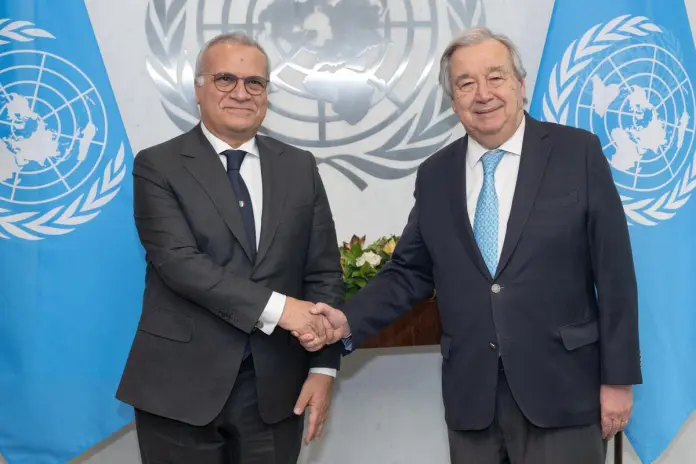
Photo: Giorgio Marrapodi (left), Permanent Representative of the Italian Republic to the United Nations, presents his credentials to Secretary-General António Guterres. UN Photo/Manuel Elias.