New York, 22 ottobre 2026
Mr. President,
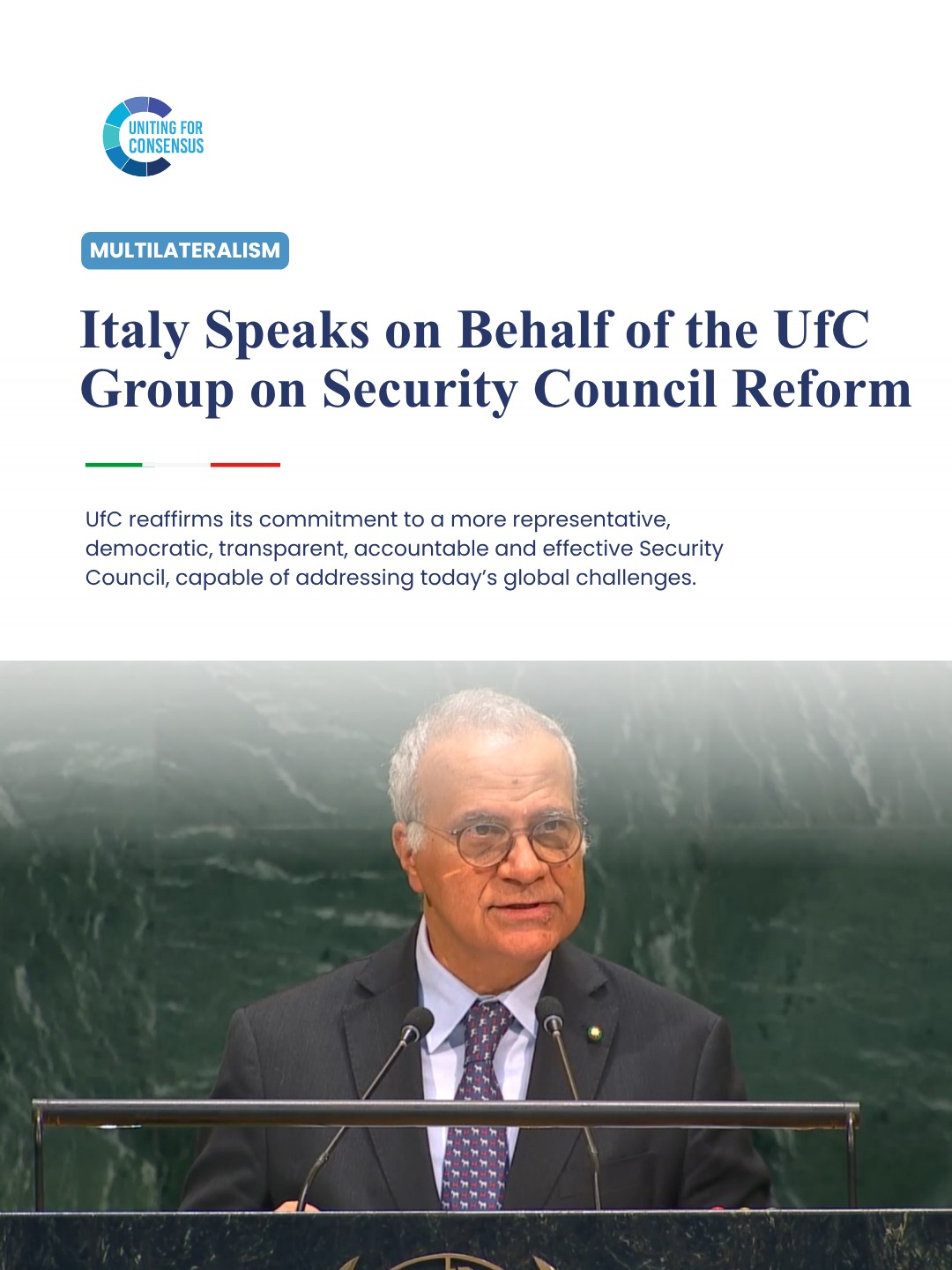
On behalf of the pro-reform and cross-regional group Uniting for Consensus (UfC)[1], I wish to express our appreciation for convening this debate.
We would also like to thank you for reappointing two highly qualified and capable Co-chairs for the Inter-Governmental Negotiations (IGN) process: Amb. Tareq Albanai, Permanent Representative of the State of Kuwait and Amb. Lise Gregoire-van Haaren, Permanent Representative of the Kingdom of the Netherlands. UfC supports their mandate and will continue to engage with them in a spirit of cooperation, with a view to building on the progress made during previous IGN.
UfC reiterates its confidence that the Co-chairs will continue leading the IGN process in an impartial, balanced and inclusive manner.
Our common goal is to work towards a Council that is more representative, democratic, transparent, accountable, effective and responsive to today’s global challenges. UfC is fully committed to a comprehensive reform that enables the Council to deliver on its critical mandate under the Charter to maintain international peace and security, addressing the existing imbalances rather than perpetuating or worsening them.
We look forward to building further on existing areas of convergence within the IGN in order to reach an agreement on a comprehensive proposal that will “garner the widest possible political acceptance by Member States”, as stated in decision 62/557. We need a reform for all, not privilege for a few – a reform that serves the interests of all member states and strengthens the Organization to meet the challenges of the future.
The Co-Chairs have a key role in facilitating a constructive and Member State-driven dialogue in the IGN, which remains the sole legitimate and inclusive platform to hold discussions on Security Council reform. Recent sessions have advanced discussions across the five interlinked clusters and on concrete reform models. The focus should now be on building consensus, reinforcing our common ground and narrowing remaining differences. There are no shortcuts in this process, and there can be no artificial deadlines.
The value of open and pragmatic dialogue within the IGN is reflected in the growing support for proposals put forward by UfC, including the rotating seat for Small Island Developing States (SIDS).
UfC has consistently worked to advance the reform, engaging with other positions and adapting its own proposal where appropriate, demonstrating flexibility and openness to compromise. We encourage all interested Member States and negotiating groups to do the same, to put forward their models and to engage constructively in the process. A broader range of proposals and perspectives will strengthen the inclusiveness and legitimacy of the reform process and contribute to a Security Council better equipped to address current and future global challenges.
The expansion of elected non-permanent membership, as proposed by the UfC model, would significantly strengthen the Council’s representativeness and broaden opportunities for all Member States – 58 of which have yet to serve on the Security Council.
By contrast, adding new permanent members would undermine the principle of equal rights and sovereign equality of States and further limit opportunities for other Member States to serve on the Council.
In this spirit, we are fully cognizant of the need to redress the historical injustice against Africa. We recognize the imperative of strengthening Africa’s representation on the Council, as well as that of other underrepresented regions such as the Asia-Pacific and Latin America and the Caribbean, and we remain committed to finding a practical solution that takes into account their legitimate aspirations.
Furthermore, the General Assembly recently agreed to continue discussions on the issue of representation of cross-regional groups, taking into account that SIDS, Arab States and others, such as the Organization of Islamic Cooperation, have been mentioned in IGN discussions.
We firmly believe that new elected, non-permanent seats are the most realistic and best way to make the Security Council more representative of, and more accountable to, the broader UN membership. Let us be realistic: how could the expansion of the Security Council’s permanent membership and the extension of veto possibly make the Council more effective? It would merely extend existing privileges to a few more States.
In this context, it is equally important to address the use and abuse of the veto that is preventing the Council from effectively fulfilling its vital mandate of maintaining international peace and security. While continuing to advocate for the suppression of the veto, we should act together in the immediate term to move towards its limitation in specific circumstances, such as, but not limited to, cases of mass atrocities and war crimes.
Finally, at a time of growing global challenges, Security Council reform should also strengthen its working methods and ensure greater coherence across the UN system. This includes more complementarity and a mutually reinforcing relationship between the Council and the General Assembly, stronger engagement with the Peacebuilding Commission, and enhanced cooperation with multilateral and regional partners, including the African Union.
Mr. President,
UfC remains committed to working constructively with you, the Co-Chairs of the IGN, other Member States and negotiating groups in advocating for a reform that reflects the shared aspirations for a Security Council that truly serves the global community, in line with its critical mandate.
I thank you.
[1] Argentina, Canada, Colombia, Costa Rica, Italy, Malta, Mexico, Pakistan, Republic of Korea, San Marino, Spain and Türkiye.